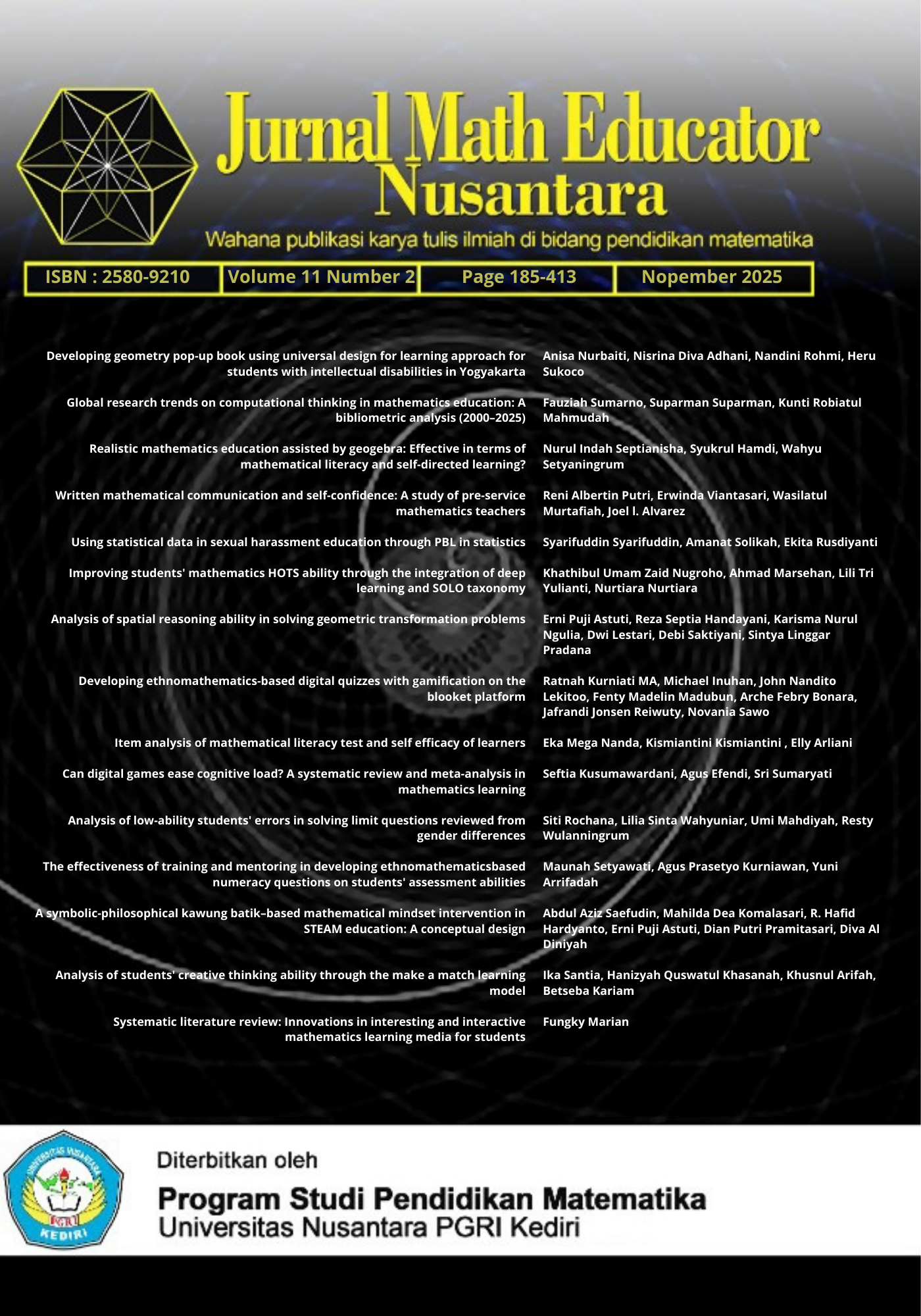
Can digital games ease cognitive load? A systematic review and meta-analysis in mathematics learning
DOI:
https://doi.org/10.29407/jmen.v11i2.27331Keywords:
Digital games, Mathematics learning, cognitive load, Meta-analysisAbstract
Mathematics learning often burdens students' cognitive capacity, hindering their understanding of concepts and mastery of the material. Digital Game-Based Learning (DGBL) offers a promising approach to address this challenge, but its effectiveness remains a subject of debate. This research employs a Systematic Literature Review and meta-analysis to analyze 15 empirical studies. The primary objective is to evaluate the impact of DGBL on cognitive load, identify research trends, and determine the factors that moderate its effectiveness. The meta-analysis definitively demonstrates that DGBL has a significant and medium effect on reducing students' cognitive load in mathematics learning. Further analysis reveals that the type of mathematics content and game genre act as significant moderators. Specifically, DGBL exhibits superior effectiveness in reducing cognitive load with algebra and geometry material compared to arithmetic, percentages, patterns, number lines, and graphs. Moreover, simulation and puzzle genres prove more effective than role-playing and adventure genres. This research highlights the importance of carefully considering the selection of content and game genre when implementing DGBL to optimize the reduction of cognitive load in elementary schools. These findings provide valuable insights for educators and educational software developers in designing more effective learning interventions tailored to students’ needs.
References
Al-Barakat, A. A., Alali, R. M., Al-Hassan, O. M., & Aboud, Y. Z. (2025). Evaluating the Effectiveness of Electronic Games-Based Learning in Enhancing Children's Multiplication Skills and Cognitive Achievement. International Journal of Information and Education Technology, 15(5). https://doi.org/10.18178/ijiet.2025.15.5.2301
Arztmann, M., Alfaro, J. L. D., Hornstra, L., Wong, J., Jeuring, J., & Kester, L. (2025). To move or not to move? The effect of active versus passive pre-training on cognitive load and in-game performance in an AR game. British Journal of Educational Technology, 1–20. https://doi.org/10.1111/bjet.13565
Avgerinou, V. A., & Tolmie, A. (2020). Inhibition and cognitive load in fractions and decimals. British Journal of Educational Psychology, 90(S1). https://doi.org/10.1111/bjep.12321
Barz, N., Benick, M., Dörrenbächer-Ulrich, L., & Perels, F. (2024). The Effect of Digital Game-Based Learning Interventions on Cognitive, Metacognitive, and Affective-Motivational Learning Outcomes in School: A Meta-Analysis. Review of Educational Research, 94(ue 2)). https://doi.org/10.3102/00346543231167795
Brydges, C. R. (2019). Effect Size Guidelines, Sample Size Calculations, and Statistical Power in Gerontology. Innovation in Aging, 3(4). https://doi.org/10.1093/geroni/igz036
Cai, Z., Mao, P., Wang, D., He, J., Chen, X., & Fan, X. (2022). Effects of Scaffolding in Digital Game-Based Learning on Student's Achievement: a Three-Level Meta-analysis. Educational Psychology Review, 34(ue 2)). https://doi.org/10.1007/s10648-021-09655-0
Chang, C. C., & Yang, S. T. (2023). Interactive effects of scaffolding digital game-based learning and cognitive style on adult learners' emotion, cognitive load and learning performance. International Journal of Educational Technology in Higher Education, 20(1). https://doi.org/10.1186/s41239-023-00385-7
Chen, C. C., & Huang, P. H. (2023). The effects of STEAM-based mobile learning on learning achievement and cognitive load. Interactive Learning Environments, 31(1). https://doi.org/10.1080/10494820.2020.1761838
Cho, I. H., Yeo, J. H., Hwang, G. H., & Yang, H. H. (2022). Impact of a virtual environment on the learning effectiveness, motivation, cognitive load, and group self-efficacy of elementary school students in collaborative learning. Educational Technology Research and Development, 70(6), 2145–2169. https://doi.org/10.1007/s11423-022-10159-z
Chu, H. C., Chen, J. M., Kuo, F. R., & Yang, S. M. (2021). Development of an Adaptive Game-Based Diagnostic and Remedial Learning System Based on the Concept-Effect Model for Improving Learning Achievements in Mathematics. Educational Technology and Society, 24(4), 36–53.
Cooper, H., Hedges, L. V., & Valentine, J. C. (2009). Handbook of Research Synthesis and Meta-Analysis 2nd Edition. In Russell Sage Foundation. Russell Sage Foundation.
Dan, N. N., Trung, L. T. B. T., Nga, N. T., & Dung, T. M. (2024). Digital game-based learning in mathematics education at primary school level: A systematic literature review. Eurasia Journal of Mathematics, Science and Technology Education, 20(4). https://doi.org/10.29333/ejmste/14377
Egger, M., Smith, G. D., Schneider, M., & Minder, C. (1997). Bias in meta-analysis detected by a simple, graphical test. British Medical Journal, 315(7109). https://doi.org/10.1136/bmj.315.7109.629
Elford, D., Lancaster, S. J., & Jones, G. A. (2022). Exploring the Effect of Augmented Reality on Cognitive Load, Attitude, Spatial Ability, and Stereochemical Perception. Journal of Science Education and Technology, 31(3). https://doi.org/10.1007/s10956-022-09957-0
Faber, T. J. E., Dankbaar, M. E. W., Broek, W. W., Bruinink, L. J., Hogeveen, M., & Merriënboer, J. J. G. (2024). Effects of adaptive scaffolding on performance, cognitive load and engagement in game-based learning: a randomized controlled trial. BMC Medical Education, 24(1). https://doi.org/10.1186/s12909-024-05698-3
Fang, X., Ng, D. T. K., & Yuen, M. (2025). Effects of geogebra-enhanced scratch computational thinking instruction on fifth-grade students' motivation, anxiety, cognitive load. Education and Information Technologies, 30(1). https://doi.org/10.1007/s10639-024-13052-9
Gui, Y., Cai, Z., Yang, Y., Kong, L., Fan, X., & Tai, R. H. (2023). Effectiveness of digital educational game and game design in STEM learning: a meta-analytic review. International Journal of STEM Education, 10(1). https://doi.org/10.1186/s40594-023-00424-9
Hawlitschek, A., & Joeckel, S. (2017). Increasing the effectiveness of digital educational games: The effects of a learning instruction on students' learning, motivation and cognitive load. Computers in Human Behavior, 72. https://doi.org/10.1016/j.chb.2017.01.040
Higgins, J. P. T., & Thompson, S. G. (2002). Quantifying heterogeneity in a meta-analysis. Statistics in Medicine, 21(11). https://doi.org/10.1002/sim.1186
Huang, S. Y., Tarng, W., & Ou, K. L. (2023). Effectiveness of AR Board Game on Computational Thinking and Programming Skills for Elementary School Students. Systems, 11(1). https://doi.org/10.3390/systems11010025
Ilić, J., Ivanović, M., & Klašnja-Milićević, A. (2024). Effects of Digital Game-Based Learning in Stem Education on Students' Motivation: a Systematic Literature Review. Journal of Baltic Science Education, 23(1), 20–36. https://doi.org/10.33225/jbse/24.23.20
Jhang, J. N., Lin, Y. C., & Lin, Y. T. (2025). A Study on the Effectiveness of a Hybrid Digital-Physical Board Game Incorporating the Sustainable Development Goals in Elementary School Sustainability Education. Sustainability, 17(15). https://doi.org/10.3390/su17156775
Kahyaoğlu Erdoğmuş, Y., & Kurt, A. A. (2023). Digital game-based learning: Pedagogical agent and feedback types on achievement, flow experience, and cognitive load. Education and Information Technologies, 29(10). https://doi.org/10.1007/s10639-023-12368-2
Karabay, F. H., & Meşe, C. (2024). The effect of mobile scaffolding on academic achievement and cognitive load of third grade students in mathematical problem solving. Asia Pacific Education Review, 26(1). https://doi.org/10.1007/s12564-024-09951-8
Lange, C. (2023). The relationship between e-learning personalisation and cognitive load. Open Learning, 38(3). https://doi.org/10.1080/02680513.2021.2019577
Liao, C. W., Chen, C. H., & Shih, S. J. (2019). The interactivity of video and collaboration for learning achievement, intrinsic motivation, cognitive load, and behavior patterns in a digital game-based learning environment. Computers and Education, 133(July 2018), 43–55. https://doi.org/10.1016/j.compedu.2019.01.013
Lin, H. C. S., Yu, S. J., Sun, J. C. Y., & Jong, M. S. Y. (2021). Engaging university students in a library guide through wearable spherical video-based virtual reality: effects on situational interest and cognitive load. Interactive Learning Environments, 29(8), 1272–1287. https://doi.org/10.1080/10494820.2019.1624579
Liu, T., & Israel, M. (2022). Uncovering students' problem-solving processes in game-based learning environments. Computers and Education, 182(June 2021). https://doi.org/10.1016/j.compedu.2022.104462
Lu, S. J., Liu, Y. C., Chen, P. J., & Hsieh, M. R. (2020). Evaluation of AR embedded physical puzzle game on students' learning achievement and motivation on elementary natural science. Interactive Learning Environments, 28(4). https://doi.org/10.1080/10494820.2018.1541908
McCashin, L. Q., McGarvey, L., Carbonaro, M., & Yuen, C. (2019). Assessing Spatial Geometry through Digital Gameplay in a Minecraft Summer Camp. Ubiquitous Learning, 12(4), 37–57. https://doi.org/10.4324/9781315639215-2
Metwally, A. H. S., Huang, R., Palomino, P. T., & Yousef, A. M. F. (2024). The effect of micro gamified online homework on gameful experience, intrinsic motivation, engagement, and cognitive load. Education and Information Technologies(ue 0123456789)). https://doi.org/10.1007/s10639-024-12750-8
Miller-Cotto, D., & Medrano, J. (2025). Does working memory moderate the effect of fading on math performance? British Journal of Educational Psychology. https://doi.org/10.1111/bjep.12781
Moher, D., Liberati, A., Tetzlaff, J., & Altman, D. G. (2009). Preferred reporting items for systematic reviews and meta-analyses: the PRISMA statement. Journal of Clinical Epidemiology, 62(10). https://doi.org/10.1016/j.jclinepi.2009.06.005
Mooij, S. M. M., Kirkham, N. Z., Raijmakers, M. E. J., Maas, H. L. J., & Dumontheil, I. (2020). Should online math learning environments be tailored to individuals' cognitive profiles? Journal of Experimental Child Psychology, 191. https://doi.org/10.1016/j.jecp.2019.104730
Moussa-Inaty, J., Causapin, M., & Groombridge, T. (2020). Does language really matter when solving mathematical word problems in a second language? A cognitive load perspective. Educational Studies, 46(1). https://doi.org/10.1080/03055698.2018.1516629
Oughton, R., Nichols, K., Bolden, D. S., Dixon-Jones, S., Fearn, S., Darwin, S., Mistry, M., Peyerimhoff, N., & Townsend, A. (2024). Developing 'deep mathematical thinking' in geometry with 3- and 4-year-olds: a collaborative study between early years teachers and university-based mathematicians. Mathematical Thinking and Learning, 26(3), 306–325. https://doi.org/10.1080/10986065.2022.2119497
Paas, F., Tuovinen, J. E., Tabbers, H., & Gerven, P. W. M. (2003). Cognitive load measurement as a means to advance cognitive load theory. Educational Psychologist, 38(1). https://doi.org/10.1207/S15326985EP3801_8
Petko, D., Schmid, R., & Cantieni, A. (2020). Pacing in Serious Games: Exploring the Effects of Presentation Speed on Cognitive Load, Engagement and Learning Gains. Simulation and Gaming, 51(2). https://doi.org/10.1177/1046878120902502
Prabowo, A., Sugandha, A., Tripena, A., Riyadi, S., & Sukono. (2020). Analysis of napier bone usage in multiplication learning in primary school. International Journal of Scientific and Technology Research, 9(3), 5239–5244.
Sevcenko, N., Ninaus, M., Wortha, F., Moeller, K., & Gerjets, P. (2021). Measuring Cognitive Load Using In-Game Metrics of a Serious Simulation Game. Frontiers in Psychology. https://doi.org/10.3389/fpsyg.2021.572437
Seyderhelm, A. J. A., & Blackmore, K. L. (2023). How Hard Is It Really? Assessing Game-Task Difficulty Through Real-Time Measures of Performance and Cognitive Load. Simulation and Gaming, 54(3). https://doi.org/10.1177/10468781231169910
Shaame, A. A., Osaki, K. M., Anatory, J. R., & Mrutu, S. I. (2020). Exploring a Learning Management System as a Way to Improve Students' Understanding of Geometry in Secondary Schools. Africa Education Review, 17(4). https://doi.org/10.1080/18146627.2020.1868070
Shi, L., Dong, L., Zhao, W., & Tan, D. (2023). Improving middle school students' geometry problem solving ability through hands-on experience: An fNIRS study. Frontiers in Psychology. https://doi.org/10.3389/fpsyg.2023.1126047
Smyrnis, E., Ginns, P., & Bobis, J. (2022). Mimicking tracing actions enhances young children's mathematical learning. Applied Cognitive Psychology, 36(6), 1356–1364. https://doi.org/10.1002/acp.4019
Stiller, K. D., & Schworm, S. (2019). Game-Based Learning of the Structure and Functioning of Body Cells in a Foreign Language: Effects on Motivation, Cognitive Load, and Performance. In Frontiers in Education (Vol. 4). https://doi.org/10.3389/feduc.2019.00018
Su, C. H. (2017). The effects of students' learning anxiety and motivation on the learning achievement in the activity theory based gamified learning environment. Eurasia Journal of Mathematics, Science and Technology Education, 13(5). https://doi.org/10.12973/eurasia.2017.00669a
Sun, T., & Kim, J. E. (2023). The Effects of Online Learning and Task Complexity on Students' Procrastination and Academic Performance. International Journal of Human-Computer Interaction, 39(13). https://doi.org/10.1080/10447318.2022.2083462
Sweller, J. (2016). Working Memory, Long-term Memory, and Instructional Design. Journal of Applied Research in Memory and Cognition, 5(4). https://doi.org/10.1016/j.jarmac.2015.12.002
Thalheimer, W., & Cook, S. (2002). How to calculate effect sizes from published research: A simplified methodology. Work Learning Recearch, 1–9. https://pdfs.semanticscholar.org/d7f0/c3a171ffd6bad4297feeb708a2d79e06da8b.pdf?_ga=2.149295606.1950164162.1568100777-2068894367.1568100777
Tlili, A., Agyemang Adarkwah, M., Salha, S., Garzón, J., Kinshuk, & Burgos, D. (2024). The effect of educational mobile games on learning performance: a meta-analysis and research synthesis. Interactive Learning Environments. https://doi.org/10.1080/10494820.2024.2310135
Vanacore, K., Sales, A., Liu, A., & Ottmar, E. (2023, 2023). Benefit of Gamification for Persistent Learners: Propensity to Replay Problems Moderates Algebra-Game Effectiveness L@S 2023 - Proceedings of the 10th ACM Conference on Learning @ Scale, http://dx.doi.org/10.1145/3573051.3593395
Vyvey, T., Castellar, E. N., & Looy, J. (2018). Loaded with Fun? The Impact of Enjoyment and Cognitive Load on Brand Retention in Digital Games. Journal of Interactive Advertising, 18(1). https://doi.org/10.1080/15252019.2018.1446370
Wang, F., Huang, J., Zheng, X. L., Wu, J. Q., & Zhao, A. P. (2024). STEM activities for boosting pupils' computational thinking and reducing their cognitive load: Roles of argumentation scaffolding and mental rotation. Journal of Research on Technology in Education, 0(0), 1–20. https://doi.org/10.1080/15391523.2024.2398504
Weijer-Bergsma, E., & Ven, S. H. G. (2021). Why and for whom does personalizing math problems enhance performance? Testing the mediation of enjoyment and cognitive load at different ability levels. Learning and Individual Differences, 87. https://doi.org/10.1016/j.lindif.2021.101982
Xiang, M., Zhang, L., Liu, Y., Wang, X., & Shang, J. (2025). Acquisition of math knowledge in digital and non-digital game-based learning classrooms: Impact of intrinsic motivation and cognitive load. Entertainment Computing, 52(August 2024). https://doi.org/10.1016/j.entcom.2024.100869
Yang, K. H., & Chen, H. H. (2023). What increases learning retention: employing the prediction-observation-explanation learning strategy in digital game-based learning. Interactive Learning Environments, 31(6). https://doi.org/10.1080/10494820.2021.1944219
Zhang, Y., & Yu, Z. (2025). Turning Play into Progress: Unveiling the Effect of Gamified VR on Learning Through Meta-Analysis. International Journal of Serious Games, 12(3), 69–80. https://doi.org/10.17083/9a0nx770
Zhong, L. (2022). Incorporating personalized learning in a role-playing game environment via SID model: a pilot study of impact on learning performance and cognitive load. Smart Learning Environments, 9(1). https://doi.org/10.1186/s40561-022-00219-5
Zou, D., Luo, S., Xie, H., & Hwang, G. J. (2022). A systematic review of research on flipped language classrooms: theoretical foundations, learning activities, tools, research topics and findings. Computer Assisted Language Learning, 35(8). https://doi.org/10.1080/09588221.2020.1839502
Downloads
Published
Issue
Section
License
Copyright (c) 2025 Seftia Kusumawardani, Agus Efendi, Sri Sumaryati

This work is licensed under a Creative Commons Attribution 4.0 International License.
Authors who publish with this journal agree to the following terms:
- Copyright on any article is retained by the author(s).
- The author grants the journal, the right of first publication with the work simultaneously licensed under a Creative Commons Attribution License that allows others to share the work with an acknowledgment of the work’s authorship and initial publication in this journal.
- Authors are able to enter into separate, additional contractual arrangements for the non-exclusive distribution of the journal’s published version of the work (e.g., post it to an institutional repository or publish it in a book), with an acknowledgment of its initial publication in this journal.
- Authors are permitted and encouraged to post their work online (e.g., in institutional repositories or on their website) prior to and during the submission process, as it can lead to productive exchanges, as well as earlier and greater citation of published work.
- The article and any associated published material is distributed under the Creative Commons Attribution-ShareAlike 4.0 International License
How to Cite