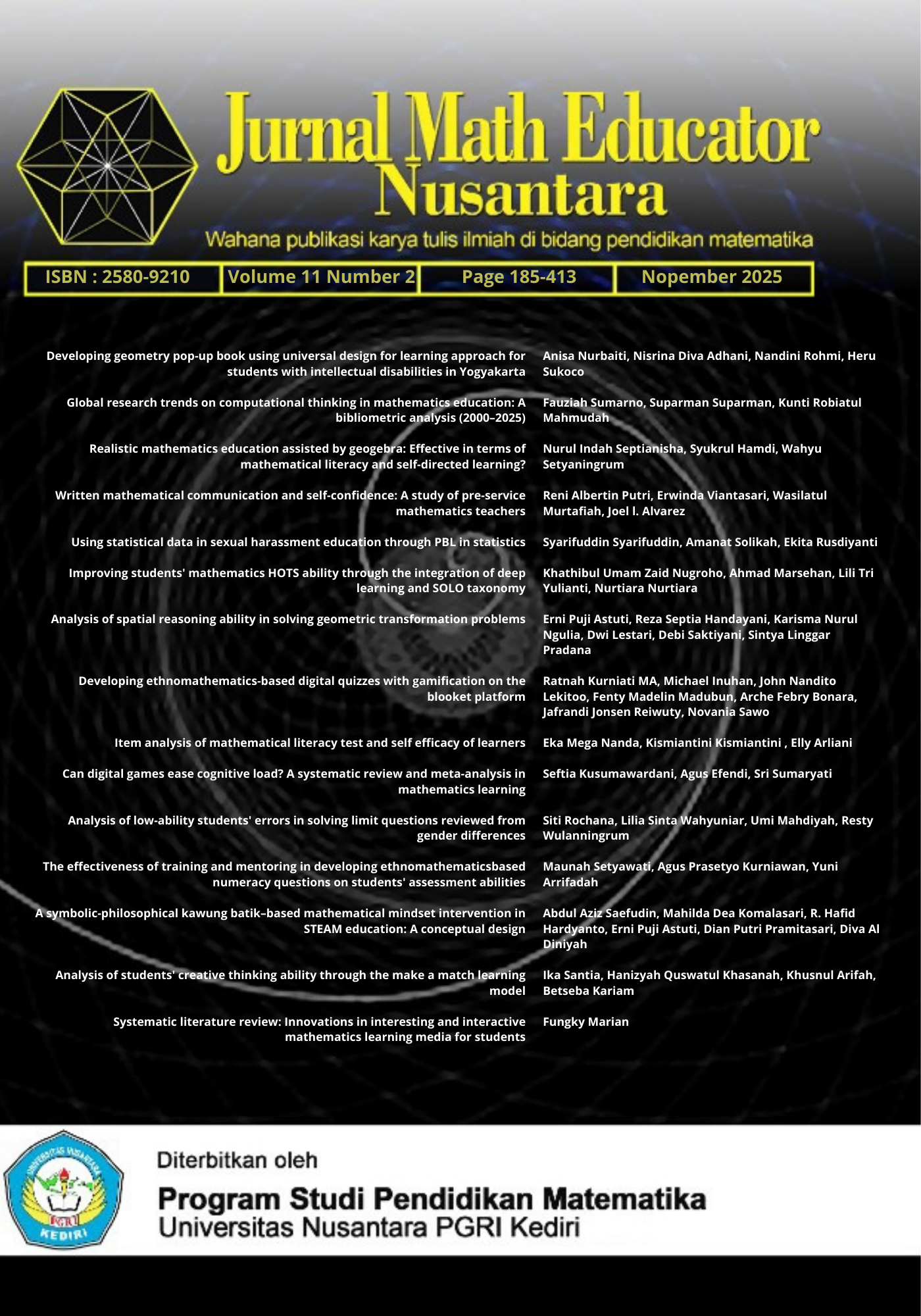
Improving students' mathematics HOTS ability through the integration of deep learning and SOLO taxonomy
DOI:
https://doi.org/10.29407/jmen.v11i2.27111Keywords:
Deep learning, SOLO Taxonomy, mathematical HOTS, high-level thinking, quasi-experimentalAbstract
Education in the 21st century requires students to have high-level thinking skills (HOTS), but the low HOTS of students' mathematics is still a significant challenge, as reflected in the results of international evaluations. This study aims to investigate the effectiveness of the integration of deep learning and SOLO Taxonomy in optimizing students' mathematics HOTS. Using a quasi-experimental design, the study involved 60 of students in grade VIII who were divided into an experimental group (n = 30) and a control group (n = 30). The experimental group received a learning intervention based on deep learning principles with the guidance of the SOLO Taxonomy, while the control group received conventional learning. Data were collected through a math HOTS pre-test and post-test and analyzed using ANCOVA to control students' initial scores. The results showed a significant increase in students' math HOTS in both groups, but the increase in the experimental group was much higher (p<0.01). The qualitative analysis of the students' responses also shows a clear development at the level of SOLO Taxonomy, from Unistructural/Multistructural to Relational and Extended Abstract. These findings indicate that the integration of deep learning and SOLO Taxonomy creates an effective synergistic effect in facilitating deep thinking. This research contributes to the educational literature by providing a measurable and practical learning model to improve HOTS, as well as providing important implications for teacher practice and curriculum development in the future.
References
Annisa, N., & Mauleto, K. (2020). Analysis of problem solving ability through problem based learning in triangle perimeter of 7th grade in Kanisius Kalasan junior high school. Universitas Sanata Dharma Mrican, Tromol Pos 29, 1470(ue 1)). https://doi.org/10.1088/1742-6596/1470/1/012076
Ansari, B. I., Kasmini, L., Maulina, S., Daud, M., & Muzakir, U. (2024). Mathematics Learning Strategies in the 21st Century: A Comparison of the Effect of the ANSARI Blended Learning Model on Students' Higher Order Thinking Skills and Perceptions in the Post Covid-19 Pandemic. Mathematics Teaching-Research Journal, 16(5), 136–156. https://www.scopus.com/inward/record.uri?eid=2-s2.0-85209756117&partnerID=40&md5=371dbf3e1bfcd5eee52e02ee72078627
Araújo, R. J., Cardoso, J. S., & Oliveira, H. P. (2019). A deep learning design for improving topology coherence in blood vessel segmentation. In S. D, Y. P.-T, L. T, P. T.m, K. A, S. L.h, E. C, & Z. S (Eds.), Lecture Notes in Computer Science (including subseries Lecture Notes in Artificial Intelligence and Lecture Notes in Bioinformatics (Vol. 11764, pp. 93–101). Springer Science and Business Media Deutschland GmbH. https://doi.org/10.1007/978-3-030-32239-7_11
Asrafil, Retnawati, H., & Retnowati, E. (2020). The difficulties of students when solving HOTS problem and the description of students cognitive load after given worked example as a feedback. Journal of Physics: Conference Series, 1511(1), 012092. https://doi.org/10.1088/1742-6596/1511/1/012092
Atasoy, E., & Konyalıhatipoğlu, M. E. (2019). Investigation of Students' Holistic and Analytical Thinking Styles in Learning Environments assisted with Dynamic Geometry Software. Egitim ve Bilim, 44(199). https://doi.org/10.15390/EB.2019.8003
Biggs, J. B., & Collis, K. F. (2004). SOLO Taxonomy and Assessing Learning to Learn.
Bintoro, H. S., Waluya, S. B., Mariani, S., Candra, S. D., Pamungkas, M. D., Rusmana, I. M., Nulhakim, A. L., Kharisudin, I., Subekti, F. E., Shodiqin, A., Sukestiyarno, Y. L., Mariani, S., Shodiqin, A., Waluya, S. B., Hakim, A. R., Cahyono, A. N., Nugraheni, N., Kusuma, D., Rohmah, S. N., & Afifa, N. N. (2021). Mathematizing Process of Junior High School Students to Improve Mathematics Literacy Refers PISA on RCP Learning. Journal of Physics: Conference Series, 1918(ue 4), 124–142. https://doi.org/10.33423/jhetp.v22i16.5596
Caridade, C. R., & Pereira, V. (2024, 2024). SOLO Taxonomy in the Evaluation of Engineering Students: A Case Study in Mathematics Springer Proceedings in Mathematics and Statistics, https://doi.org/10.1007/978-3-031-49218-1_8
Creswell, J. W. (2014). Research design: Qualitative, quantitative, and mixed methods approaches.
Darto, K., Widowati, & Mulyono. (2024). Student learning trajectories in finding the perimeter and area of a rectangular in the context of a fishing pond. Eurasia Journal of Mathematics, Science and Technology Education, 20(10). https://doi.org/10.29333/ejmste/15430
Efriani, A., Pranita, S., & Anggara, B. (2024). An analysis of student errors in solving HOTS mathematics problems based on the newman procedure. AIP Conference Proceedings, 3058(ue 1)). https://doi.org/10.1063/5.0201077
Fullan, M., Quinn, J., & McEachen, J. (2019). Book Review: Deep Learning: Engage the World Change the World. Journal of Catholic Education, 122-127. https://doi.org/10.15365/joce.2202082019
Guerrero-Ortiz, C., Reyes-Rodriguez, A., & Espinosa-Perez, H. (2015). Integrating synthetic and analytical aspects of geometry through solving problems using a DGS. In W. T, L. D, & U. L (Eds.), Communications in Computer and Information Science (Vol. 533, pp. 283–297). Springer Verlag. https://doi.org/10.1007/978-3-319-22629-3_23
Heryani, Y., Wijayanti, K., & Dewi, N. R. (2023). Analysis of Student's Mathematical Literacy Ability in Solving HOTS Problems in Minimum Competency Assessment. Journal of Higher Education Theory and Practice, 23(16), 143–157. https://doi.org/10.33423/jhetp.v23i16.6470
Hu, X. (2023). The role of deep learning in the innovation of smart classroom teaching mode under the background of internet of things and fuzzy control. Heliyon, 9(8). https://doi.org/10.1016/j.heliyon.2023.e18594
Humaira, D. F., & Putri, R. I. I. (2024). Student Critical Thinking Ability in Solving PISA-Like Mathematics Problem in The Context of Palembang Tourism "Bait Al-Quran Al-Akbar. AIP Conference Proceedings, 3052(ue 1)). https://doi.org/10.1063/5.0201017
Ingram, J., Lee, G., & Stiff, J. (2024, 2024). MATHEMATICAL REASONING AND PROBLEM-SOLVING IN PISA 2022 HOW DO PERFORMANCE PROFILES VARY ACROSS COUNTRIES?, https://www.scopus.com/inward/record.uri?eid=2-s2.0-85200229965&partnerID=40&md5=7140ab704deceda27fa3b1f3ef97b786
Jakaite, L., Schetinin, V., Hladůvka, J., Minaev, S., Ambia, A., & Krzanowski, W. (2021). Deep learning for early detection of pathological changes in X-ray bone microstructures: case of osteoarthritis. Scientific Reports, 11(1). https://doi.org/10.1038/s41598-021-81786-4
Jimoyiannis, A. (2011). Using SOLO taxonomy to explore students' mental models of the programming variable and the assignment statement. Themes in Science and Technology Education, 4(2), 53–74. http://earthlab.uoi.gr/theste/index.php/theste/article/view/99/49
Joshi, D. R., Khanal, J., Chapai, K. P. S., & Adhikari, K. P. (2025). The impact of digital resource utilization on student learning outcomes and self-efficacy across different economic contexts: A comparative analysis of PISA, 2022. International Journal of Educational Research Open, 8. https://doi.org/10.1016/j.ijedro.2025.100443
Julita, S., Sudarwan, & Dwi Anggoro, A. F. (2019). The Local Culture-Based Learning Model to Improve Teaching Abilities for Pre-Service Teachers. Journal of Physics: Conference Series, 1179(1). https://doi.org/10.1088/1742-6596/1179/1/012058
Letchumanan, M., Husain, S. K. S., Ayub, A. F. M., Kamaruddin, R., & Zulkifli, N. N. (2023). Determining the Factors that Promote Higher Order Thinking Skills in Mathematics Technology Enhanced Learning Environment: Perspective from University Students. Malaysian Journal of Mathematical Sciences, 17(1), 13–23. https://doi.org/10.47836/mjms.17.1.02
Liu, X., Hansen, K. Y., Valcke, M., & Neve, J. (2024). A decade of PISA: student perceived instructional quality and mathematics achievement across European countries. ZDM - Mathematics Education, 56(5). https://doi.org/10.1007/s11858-024-01630-7
Marleny, A. S., & Putri, R. I. I. (2024). Systematic Literature Review: Development of PISA Mathematics Minimum Competency Assessment Questions in Tourism Contexts. AIP Conference Proceedings, 3052(ue 1)). https://doi.org/10.1063/5.0201041
Martínez, V. G., Yilmaz, F., Queiruga-Dios, A., M.L.D. Rasteiro, D., Martín-Vaquero, J., & Mierluş-Mazilu, I. (2024, July 12–14). Mathematical Methods for Engineering Applications 4th International Conference on Mathematics and its Applications in Science and Engineering, ICMASE 2023. In Springer Proceedings in Mathematics and Statistics, Madrid, Spain. https://link.springer.com/book/10.1007/978-3-031-49218-1
Newton, B. G., & Martin, E. (2014). Blooming, SOLO taxonomy, and phenomenography as analytic methods: use in higher education and relationships with student learning approach.
Nugroho, W., Kholid, M. N., & Utami, R. T. (2024). Defragmenting mathematical literacy in solving system of two-variable linear equations (STLE. AIP Conference Proceedings, 2926(ue 1)). https://doi.org/10.1063/5.0182802
Nur, N., & Yulianti, K. (2020). Analysis of Mathematics Problem Solving Ability Viewed from Students' Cognitive Style. Proceedings Stemeif, 6(1), 13–17. https://doi.org/10.30596/ijems.v6i1.21723
O.e.c.d. (2021). PISA 2021 MATHEMATICA FRAMEWORK.
O.e.c.d. (2023). PISA 2022 Results Factsheets Indonesia. OECD (Organisation for Economic Co-Operation and Development. Publication. https://www.oecd.org/en/publications/pisa-2022-results-volume-i-and-ii-country-notes_ed6fbcc5-en/indonesia_c2e1ae0e-en.html
Octaria, D., Ningsih, Y. L., Destiniar, D., & Fitriasari, P. (2022). Development of Higher Order Thinking Skills (HOTS) Test Instruments in Geometry. https://doi.org/10.31764/jtam.v6i4.8808
OECD. (2019). An OECD learning framework 2030. In The future of education and labor (pp. 23-35). Springer.
Ortega-Rodríguez, P. J. (2025). Pisa 2022: The impact of school-environment predictors on the performance of spanish students. Revista Espanola de Pedagogia, 83(290), 223–240. https://doi.org/10.22550/2174-0909.4100
Padiotis, I., & Mikropoulos, T. A. (2010). Using SOLO to Evaluate an Educational Virtual Environment in a Technology Education Setting. Technology Education Setting. Educational Technology & Society, 13(3), 1176–3647. https://doi.org/10.2307/jeductechsoci.13.3.233
Panggabean, E. M., Haryati, F., & Wahyuni, S. (2022). Development of Mathematics Assessment Instruments for High School Students Based on Higher-Order Thinking Skills (HOTS. AL-ISHLAH: Jurnal Pendidikan, 14(4). https://doi.org/10.35445/alishlah.v14i4.1411
Prayitno, L. L., Purwanto, P., Subanji, S., Susiswo, S., & As'ari, A. R. (2020). Exploring student's representation process in solving ill-structured problems geometry. Participatory Educational Research, 7(2), 183–202. https://doi.org/10.17275/PER.20.28.7.2
Putri, R. I. I. (2023). Developing a workshop model for high school mathematics teachers constructing HOTS questions through the Pendidikan Matematika Realistik Indonesia approach. Journal on Mathematics Education, 14(4), 603–626. https://doi.org/10.22342/jme.v14i4.pp603-626
Putri, U. H., Mardiyana, M., & Saputro, D. R. S. (2017). How to Analyze the Students' Thinking Levels Based on SOLO Taxonomy? Journal of Physics: Conference Series, 895(1). https://doi.org/10.1088/1742-6596/895/1/012031
Samejima, T., Goto, K., Nouchi, Y., Iida, H., & Tosa, S. (2022). The Significance of Inquiry-based Learning of IB programme from the Perspective of Active Learning. New Perspectives in Science Education - International Conference (Vol(ue 11)). https://www.scopus.com/inward/record.uri?eid=2-s2.0-85216750290&partnerID=40&md5=f3d614207afcf10b01d9d0340a59fa17
Sari, P. P., & Slamet, I. (2018, 2018). Improving mathematical understanding using a cooperative learning model with HOTS questions in the study of geometry AIP Conference Proceedings, https://doi.org/10.1063/1.5062827
Sepriliani, S. P. (2023). Development of PISA-like Activities using the Inquiry-based Learning Model and the Context of Religious Holidays during the Pandemic. Mathematics Education Journal, 17(1), 37–54. https://doi.org/10.22342/jpm.17.1.17765.37-54
Setyaningsih, N., & Safi'I, I. B. (2024). Students' ability in solving linear program APOS theory reviewed from prior knowledge. AIP Conference Proceedings, 3024(ue 1)). https://doi.org/10.1063/5.0204377
Sofyan, F. A., Sartono, E. K. E., Badaruddin, K., Fauzi, M., Oviyanti, F., & Soraya, N. (2024). Analysis of Higher-Order Thinking Skill (HOTS) of Madrasah Ibtidaiyah students in solving open-ended mathematics problems. AIP Conference Proceedings, 3058(ue 1)). https://doi.org/10.1063/5.0201104
Sugiharti, G., Siregar, M. I., Samosir, D., & Anugrah, A. N. (2024). Improving Student's Critical Thinking Ability Using HOTS-Based Modules in Chemistry Learning. Journal of Ecohumanism, 3(4), 118–127. https://doi.org/10.62754/joe.v3i4.3494
Utami, M. R. P., & Putri, R. I. I. (2023). Students' Critical Thinking Skills in Solving PISA-Like Questions in the Context of the Jakabaring Palembang Tourism. Mathematics Education Journal, 17(2), 135–148. https://doi.org/10.22342/jpm.17.2.19371.135-148
Widada, W., Herawaty, D., Ariska, S., Afifah, R., & Anggoro, A. F. D. (2020). The characteristics of relational students in understanding the concepts of normal subgroups. Journal of Physics: Conference Series, 1470(1). https://doi.org/10.1088/1742-6596/1470/1/012069
Widada, W., Herawaty, D., & Lubis, A. N. M. T. (2018). Realistic mathematics learning based on the ethnomathematics in Bengkulu to improve students' cognitive level. Journal of Physics. https://doi.org/10.1088/1742-6596/1088/1/012028
Widada, W., Sunardi, H., Herawaty, D., Pd, B. E., & Syefriani, D. (2018). Abstract Level Characteristics in SOLO Taxonomy during Ethnomathematics Learning. International Journal of Science and Research (IJSR, 7(8), 352–355. https://doi.org/10.21275/ART2019438
Yani, M., Rosma, F., & Helmanda, C. M. (2022). Improving Students' Mathematical Problem Solving Ability By Using Macromedia Flash on Geometry Materials. Matematika Dan Pembelajaran, 10(1), 1–12. https://doi.org/10.33477/mp.v10i1.2759
Zhang, X., Song, Z., Liang, Q., & Gao, S. (2022). Yield and maturity estimation of apples in orchards using a 3-step deep learning-based method. Quality Assurance and Safety of Crops and Foods, 14(2). https://doi.org/10.15586/QAS.V14I2.1008
Zulfah, Z., Astuti, A., Ezaldi, D., Firmansyah, E. H., Risali, H., Suryani, L., Putri, M. F., Aristi, R., & Rahmadani, Y. (2022). Meta Analisis: High Order Thinking Skills. Journal on Education, 4(3), 891–896. https://doi.org/10.31004/joe.v4i3.501
Downloads
Published
Issue
Section
License
Copyright (c) 2025 Khathibul Umam Zaid Nugroho, Ahmad Marsehan, Lili Tri Yulianti, Nurtiara Nurtiara

This work is licensed under a Creative Commons Attribution 4.0 International License.
Authors who publish with this journal agree to the following terms:
- Copyright on any article is retained by the author(s).
- The author grants the journal, the right of first publication with the work simultaneously licensed under a Creative Commons Attribution License that allows others to share the work with an acknowledgment of the work’s authorship and initial publication in this journal.
- Authors are able to enter into separate, additional contractual arrangements for the non-exclusive distribution of the journal’s published version of the work (e.g., post it to an institutional repository or publish it in a book), with an acknowledgment of its initial publication in this journal.
- Authors are permitted and encouraged to post their work online (e.g., in institutional repositories or on their website) prior to and during the submission process, as it can lead to productive exchanges, as well as earlier and greater citation of published work.
- The article and any associated published material is distributed under the Creative Commons Attribution-ShareAlike 4.0 International License
How to Cite