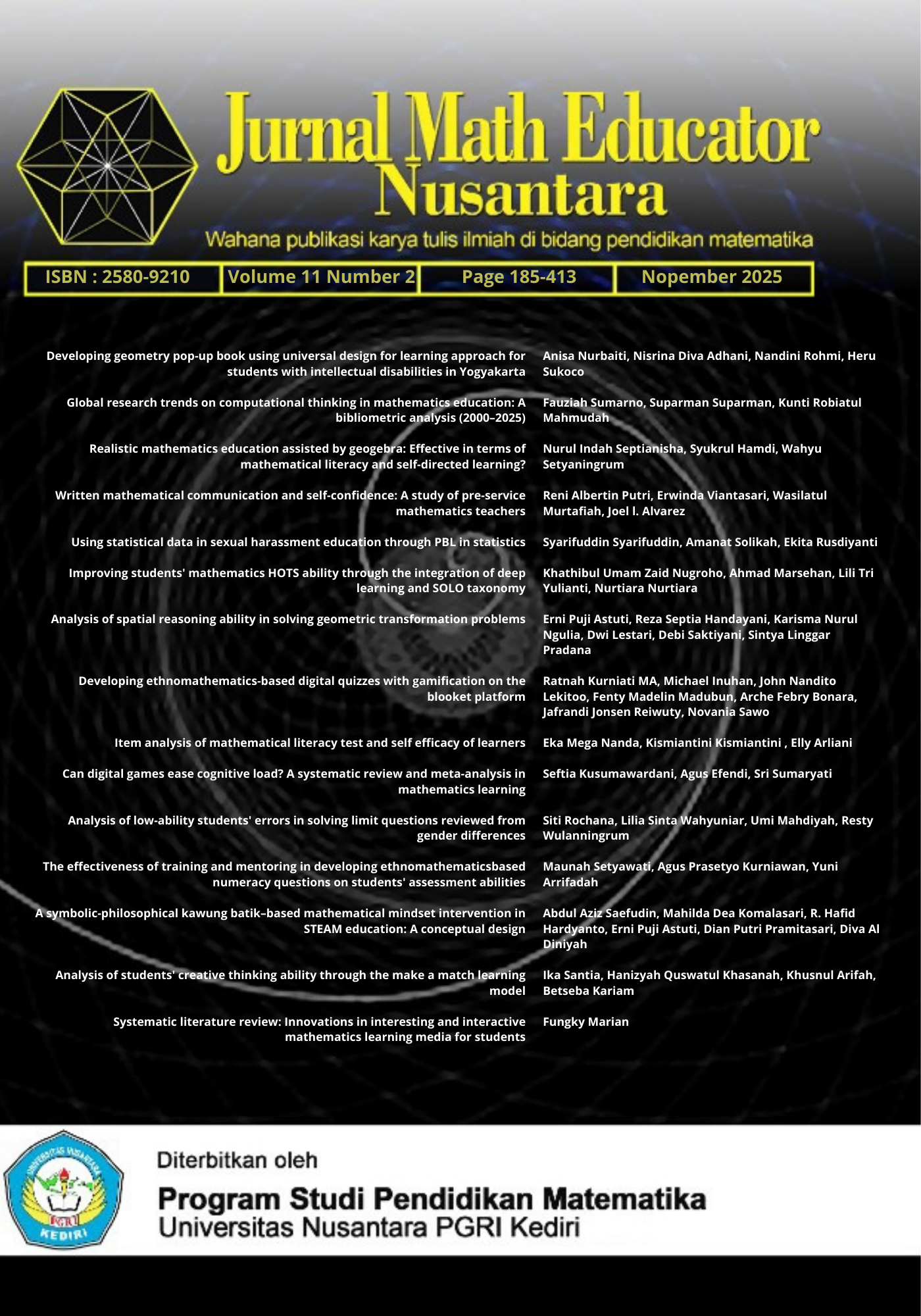
Using statistical data in sexual harassment education through PBL in statistics
DOI:
https://doi.org/10.29407/jmen.v11i2.27078Keywords:
Problem Based Learning, sexual harassment, statistics, contextual learning, primary educationAbstract
The increasing prevalence of sexual harassment cases within educational settings underscored the urgency of integrating social issues into the learning process. This study examined the effect of implementing a Problem-Based Learning (PBL) model based on sexual harassment case data on students’ understanding of statistical concepts and data processing skills. A pre-experimental research design with a one-group pretest–posttest model was employed. The sample consisted of 100 fifth-grade students from Muhammadiyah 18 Elementary School in Surabaya, selected through purposive sampling. The research instrument was a statistical concept comprehension test, and the data were analyzed using a paired sample t-test. The analysis results showed a correlation coefficient of 0.662 with a significant value of p < 0.001, indicating that the implementation of the PBL model significantly improved students’ conceptual understanding. The effect size (Cohen’s d = 0.97) indicated a large practical impact of the intervention. These findings suggest that embedding real social issues into mathematics and statistics instruction can simultaneously strengthen cognitive skills and foster social awareness among students. However, as this study employed a one-group pretest–posttest design, further research with control groups is recommended to strengthen generalisability
References
Anggara, A. S., Ruzuar, A. H., Ridwan, A. I., & Dkk. (2023). Kekerasan Terhadap Perempuan di Ranah Publik dan Negara: Minimnya Perlindungan dan Pemulihan (1st ed.). Komisi Nasional Anti Kekerasan terhadap Perempuan.
Aranditio, S. (2023). Terjadi 136 Kasus Kekerasan di Sekolah Sepanjang 2023, 19 Orang Meninggal. Kompas. Id. https://www.kompas.id/baca/humaniora/2023/12/16/terjadi-136-kasus-kekerasan-di-sekolah-sepanjang-2023
Aranditio, S. (2024). Kekerasan di Sekolah Melonjak, Ratusan Anak Jadi Korban. kompas.id. Retrieved 30 September 2024 from https://www.kompas.id/artikel/kekerasan-di-sekolah-melonjak-ratusan-anak-jadi-korban
Barrows, H. S. (1996). Problem-based learning in medicine and beyond: A brief overview. New directions for teaching and learning, 1996(68). https://doi.org/10.1002/tl.37219966804
Bato, S. (2023). Persepsi Guru PAI SMA UII Terhadap Solusi Melawan Kekerasan di Lembaga Pendidikan Islam.
Cohen, L., Manion, L., & Morrison, K. (2002). Research methods in education. routledge.
Efendi, Y., & Bari, F. (2023). Penerapan Sanksi Pidana Dan Sosial Bagi Pelaku Tindak Pidana Kekerasan Seksual (Vol. 1). Jurnal Ilmu Hukum Dan Sosial.
Fadlelmola, F. M. (2023). Effectiveness of problem-based learning compared to lecture-based learning in medical education: A systematic review and meta-analysis. BMC Medical Education, 23. https://doi.org/10.1186/s12909-023-04265-1
Febrian, R., Rahmawati, S., Saskia, S., & Syafruddin, S. (2025). Penerapan Metode Project-Based Learning Dalam Pembelajaran Ips Untuk Meningkatkan Kreativitas Dan Empati Sosial Siswa Sekolah Dasar. Indonesian Journal of Innovation Science and Knowledge, 2(2), 43-53. https://doi.org/https://doi.org/10.31004/ijisk.v2i2.158
Fitriani, D., & Putra, A. (2022). Systematic Literature Review (SLR): Eksplorasi Etnomatematika pada Makanan Tradisional. Journal of Mathematics Education and Learning, 2(1). https://doi.org/10.19184/jomeal.v2i1.29093
Gaffney, A. L. H. (2022). Effectiveness of problem-based learning on knowledge, problem-solving, and self-directed learning: A systematic review and meta-analysis. PLOS ONE, 17(5). https://doi.org/10.1371/journal.pone.0267430
Handayani, E. F. (2023). Penerapan Model Problem Based Learning Bermuatan Ethnoscience (Ethno-Pbl) Terhadap Hasil Belajar Kognitif Siswa Sekolah Dasar. Jurnal Citra Pendidikan, 3(4), 1288-1297. https://doi.org/https://doi.org/10.38048/jcp.v3i4.1935
Hmelo-Silver, C. E. (2004). Problem-Based Learning: What and How Do Students Learn? Educational Psychology Review, 16(3), 235–266. https://doi.org/10.1023/B:EDPR.0000034022.16470.f3
Huber, J. (2024). Problem-based learning and development of 21st-century skills: An integrated review. Nurse Educator, 49(1). https://doi.org/10.1097/NNE.0000000000001256
La Nani, K., Bakar, M. T., & Saidi, S. (2020). Peningkatan Kemampuan Penalaran Statistis Mahasiswa Melalui Pembelajaran Berbasis Proyek Berbantuan ICT. Edukasi, 18(2), 304-319. https://doi.org/10.33387/Edu
Listyarti, R., & Purnomo, H. (2024). Federasi Serikat Guru Indonesia (FSGI) Rilis Kasus Kekerasan di Dunia Pendidikan Selama Januari-September 2024. Bidikekspres. Id. https://bidikekspres.id/2024/09/29/federasi-serikat-guru-indonesia-fsgi-rilis-kasus-kekerasan-di-dunia-pendidikan-selama-januari-september-2024/
Maulana, D. I., & Fadhilah, I. (2024). Peran Pemerintah dalam Upaya Perlindungan Anak dari Kekerasan Seksual di Wilayah Kota Surabaya. Neraca: Jurnal Ekonomi, Manajemen Dan Akuntansi, 2(9), 404–418.
Nahar. (2024). Kolaborasi Berkelanjutan Lintas Sektor dan Regional, Kunci Atasi Kasus Kekerasan terhadap Anak. Kemenpppa. Go. Id. https://www.kemenpppa.go.id/page/view/NTAxNg==
Nurzaman. (2017). The Use of Problem-Based Learning Model to Improve Quality Learning Students Morals. Journal of Education and Practice, 8(9), 234–245. www.iiste.org
O.e.c.d. (2021). 21st Century Readers: Developing Literacy Skills in a Digital World. https://doi.org/10.1787/a83d84cb-en
Peters, R. M. (2022). Integrating social issues into science and math education: Enhancing contextual learning. Journal of Educational Research and Innovation, 10(2), 45–58. https://doi.org/10.24059/olj.v26i1.2971
Rahayuni, I. G. A. A., Dumaini, N. K. D., & Ardhiani, G. A. N. (2024). Peran Pembelajaran IPS di Sekolah Dasar dalam Mencegah Pelecehan Seksual Terhadap Anak. Jurnal Lampuhyang, 15(1), 63–73.
Sari, N. (2024). Kekerasan seksual terhadap anak: Definisi dan jenis (S. Oliviate, Ed.). DSI Press.
Shantha Nair, S., Smritika, S. P., & Thomas, K. A. (2020). Revitalizing Education through Problem based Learning Practices. Shanlax International Journal of Education, 9(1), 109–117. https://doi.org/10.34293/education.v9i1.3436
Sugiyono. (2021). Metode penelitian kuantitatif, kualitatif, dan R&D. ALFABETA.
Supriani, R. A., & Ismaniar, I. (2022). Upaya Pencegahan Kekerasan Seksual Pada Anak Usia Dini. Jambura Journal of Community Empowerment, 3(1). https://doi.org/10.37411/jjce.v3i2.1335
Yenizar, N. (2015). Fungsi, Kegunaan dan Peranan Statistika. Jurnal Pendidikan Islam, 1(1), 120–128. http://ejournal.iainbatanghari.ac.id/index.php/attasyrih/article/view/18/6
Downloads
Published
Issue
Section
License
Copyright (c) 2025 Syarifuddin Syarifuddin, Amanat Solikah, Ekita Rusdiyanti

This work is licensed under a Creative Commons Attribution 4.0 International License.
Authors who publish with this journal agree to the following terms:
- Copyright on any article is retained by the author(s).
- The author grants the journal, the right of first publication with the work simultaneously licensed under a Creative Commons Attribution License that allows others to share the work with an acknowledgment of the work’s authorship and initial publication in this journal.
- Authors are able to enter into separate, additional contractual arrangements for the non-exclusive distribution of the journal’s published version of the work (e.g., post it to an institutional repository or publish it in a book), with an acknowledgment of its initial publication in this journal.
- Authors are permitted and encouraged to post their work online (e.g., in institutional repositories or on their website) prior to and during the submission process, as it can lead to productive exchanges, as well as earlier and greater citation of published work.
- The article and any associated published material is distributed under the Creative Commons Attribution-ShareAlike 4.0 International License
How to Cite